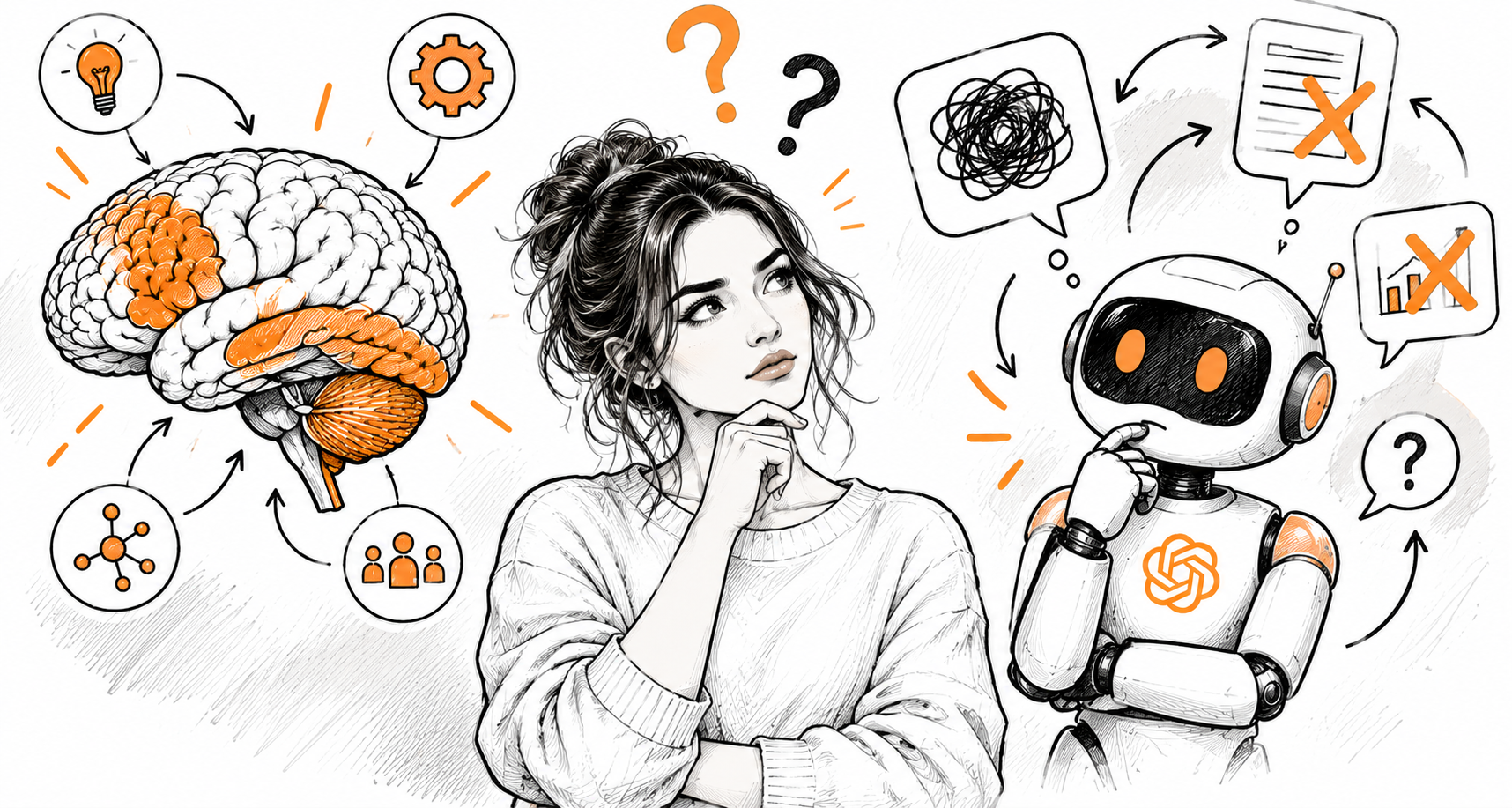
Organisations are spending thousands on AI training, and it’s just not working.
Here are five neuroscience-based reasons your people are struggling to adopt AI – and what to do about each one.
1. The Threat Response
The human brain is a prediction machine. Change, even positive change, disrupts that stability, and the brain treats it as a threat. The amygdala activates, the prefrontal cortex function drops, working memory shrinks, and people lose access to the rational thinking they need to engage with something new.
What to do:
- Communicate repeatedly, what’s your business and leadership position on AI?
- Make space for people’s emotional responses to AI.
- Give people autonomy, wherever possible, in how they engage with AI, even small choices reduce the threat response.
2. Loss Aversion.
The brain has evolved to protect what it already has, and we weigh potential losses two to three times more heavily than equivalent gains. So when someone hears “AI will transform your role,” their brain doesn’t hear opportunity. It hears loss of identity, status, expertise, familiarity, and time.
What to do:
- Acknowledge what people feel they’re losing before you sell the benefits
- Make the benefits personal and concrete – not a corporate vision, but a clear picture of how AI will make their specific work better.
- Help people experience benefits immediately
3. Psychological Transition
People don’t leap from old to new. They move through distinct psychological phases: an ending, a messy and uncertain middle (the neutral zone), and eventually a new beginning. Each phase involves different cognitive states. Push someone into AI training before they’ve psychologically let go of the old way of working, and it simply won’t stick.
What to do:
- Assess where people actually are in transition, not where they want to be.
- Match your training and support to their psychological readiness. and sequence your interventions accordingly.
- Don’t force change before people are ready.
4. Social Cognition.
The brain is profoundly social. We unconsciously model the behaviour of people we respect and trust, especially during periods of uncertainty. If your leaders aren’t visibly using AI, experimenting with it, and talking openly about what they’re learning, neither will anyone else. And if failure feels risky, adoption dies. People need to feel safe experimenting, making mistakes, and learning publicly.
What to do:
- Leaders must visibly and consistently role-model AI use.
- Identify AI champions and create peer-to-peer mentoring.
- Make it psychologically safe to experiment and make mistakes. Learning requires safety
5. Cognitive Overload
People’s brains are already maxed out. Demanding workloads, fast pace, competing priorities, constant deadlines. There is simply no cognitive bandwidth left for learning something new. You cannot bolt AI adoption onto an already overloaded brain and expect it to work.
What to do:
- Don’t just add AI to the list. Reduce competing priorities.
- Protect dedicated time for learning and experimentation.
- Create the cognitive space people need to actually engage with new tools.
The Bottom Line
The challenges to AI adoption aren’t technical. They’re psychological and neurological.
If you’re leading your organisation through AI disruption, you have to lead with the brain in mind. Because if you don’t, you’ll keep running into the same resistance, no matter how good your training programme is.
These five principles come from the REWIRE Model, a neuroscience-based framework for leading organisational change. If you’re navigating or leading change and want to understand how to lead with the brain in mind, get in touch.