


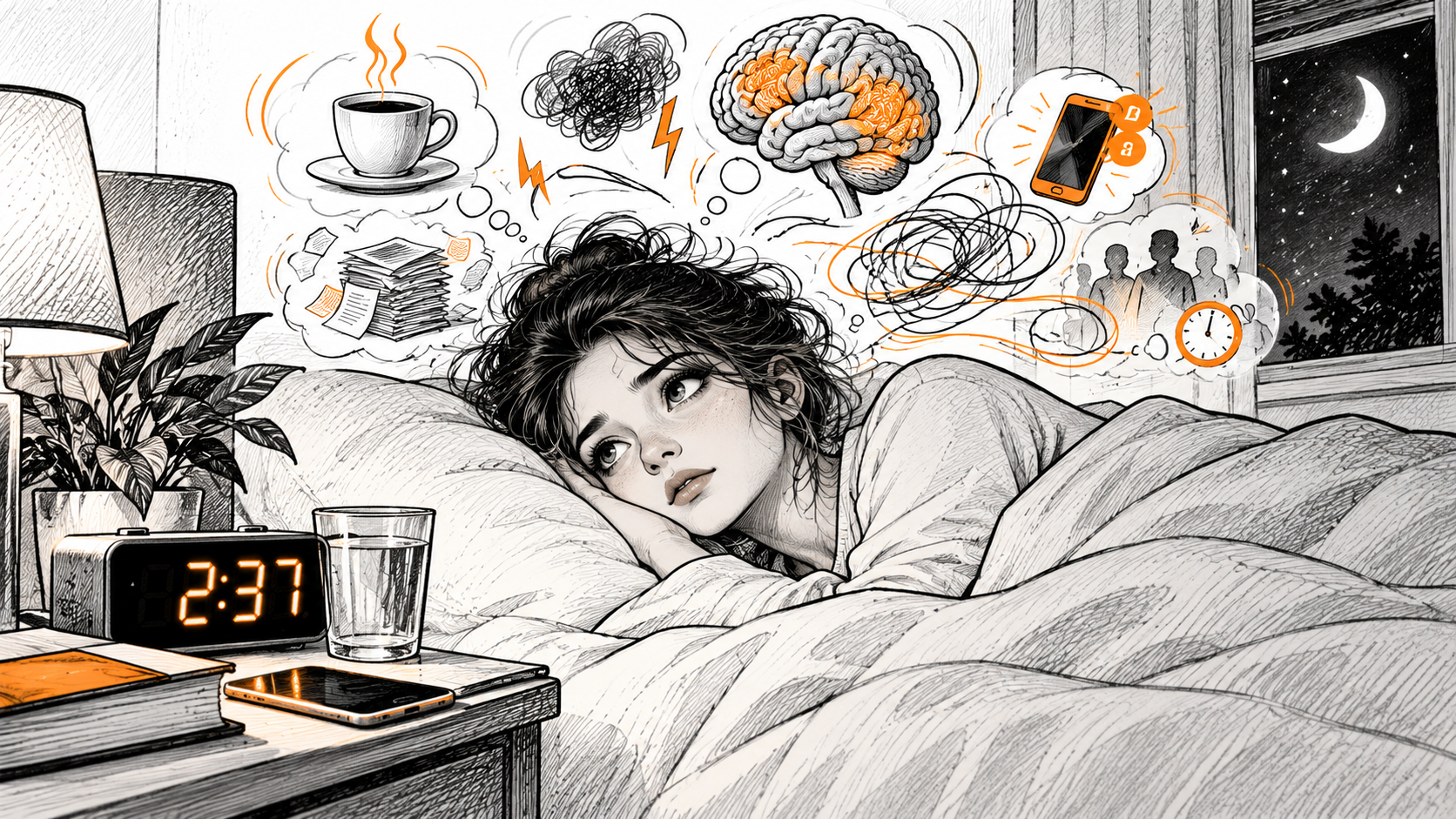
Why are so many of us struggling with sleep at the moment?
Whether it’s due to mental overload, uncertainty-related anxiety, or rising existential threat, it’s a pattern I’m noticing everywhere. People are struggling to fall asleep, stay asleep, or find enough hours in the day to get enough sleep.
So here is a checklist to help you improve your sleep. Below that are my responses to the questions I get asked most about sleep and its role in cognitive fitness…
How to fall asleep faster
Think about this in terms of creating the right three conditions
1) Environmental conditions.
Start with the basics: Make sure your bedroom is cool (18 degrees), dark and quiet. London seems to be getting noisier by the month. If you need earplugs, buy them.
2) Physiological conditions.
If you’re under a lot of pressure, or you have a lot on your mind, your nervous system will be too aroused for you to fall asleep when you want. For this you need to create parasympathetic dominance. Top 3 techniques (you can do these either in bed, or as part of your wind down routine before bed)
-
- Extended out-breathing – e.g. 4 seconds in, 8 seconds out to fully empty your lungs (for rapid state shifting)
- Progressive relaxation (for whole body relaxation)
- Meditation or mindfulness (for calming both body and mind)
It’s also important that your body is cool and free from stimulants and other sleep disuptors
-
-
- Finish strenuous exercise at least two hours before bed (it raises your core temperature)
- Avoid caffeine and chocolate from early afternoon (both stimulants).
- Avoid alcohol (helps you fall asleep but then massively fragments your sleep)
-
3) Mental conditions.
If you find your mind unable to switch off, understand the importance of creating the right mental conditions. Top 6 tips for this:
-
-
-
- Stop working at least two hours before bed (no more emails or planning – it can all wait)
- No devices in the last hour before bed (reading on a Kindle is fine, but get off your phone)
- Remove your phone from your bedroom (buy a clock if you need)
- Do a weekly ‘brain sweep‘ (to clear your mind)
- Do a focused meditation in bed (to calm your mind)
- Do a cognitive shuffle in bed (to distract your mind from overthinking)
-
-
Finally try to have a consistent sleep schedule – going to bed and waking up at the same time every day. Falling asleep fast depends on sleep pressure and circadian timing, and both are anchored by when you wake up. Weekend lie-ins are lovely, but increase your consistency if you need to get your sleep back on track.
What should you do if you wake up in the middle of the night?
Brief awakenings are a normal part of sleep. It’s only a problem if your mind becomes too active and you can’t get back to sleep.
The tips mentioned above are the best way to avoid this, but if you do still wake up, try to avoid checking the time and resist the temptation to reach for your phone. Instead, do this:
-
- Do extended out-breaths or relaxation
- Count down from 100 to 1
- Do a cognitive shuffle
- Recall how profound sleepiness feels (heavy limbs, slow breathing, eyes that won’t stay open)
If you’re lying awake for a prolonged period (feel like more than about 20 minutes), get up and do something quiet and relaxing in dim light. Return to bed when you feel sleepy.
Here is an even more comprehensive checklist to fall asleep quicker, stay asleep for longer, and wake feeling more rested than you may have done in a long while.
Is six hours of sleep enough?
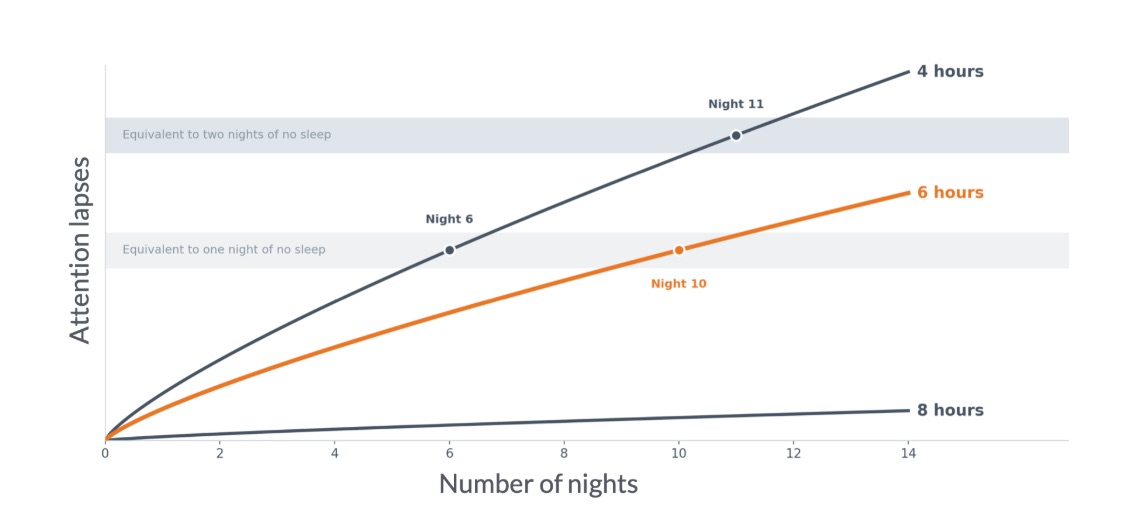
Unfortunately not. Consistently sleeping for six hours or less progressively impairs your attention, working memory, decision-making, and emotional regulation.
See the image below – six hours for ten nights in a row leads to negative effects (reaction times and attention) equivalent to a night entirely without sleep.
Those people who feel they only need six hours are good examples of how we’re poor judges of how impaired we’ve become.
If you want to think well, make good decisions and be able to manage your emotions, sleep is non-negotiable.
”Without enough sleep, we all become tall two year olds
Jojo Jensen
Can you make up for lost sleep?
If you’ve had a week of poor sleep, a weekend lie-in will restore some alertness. But it also pushes your body clock later, making Monday morning feel worse. And it can’t recover what the week cost you. The memories you didn’t consolidate are gone, and the decisions you made tired are already made.
So the goal should always be consistent, good-quality sleep, rather than a weekly cycle of deprivation and recovery.
Are there supplements that can help you sleep?
The evidence is less convincing than the marketing might suggest.
- Magnesium glycinate is sometimes recommended for sleep onset, and some studies suggest modest benefits, but the overall evidence is limited.
- Melatonin can help in particular circumstances, especially when your body clock is disrupted, but it’s not a universal solution for insomnia – and in the UK, it’s a prescription-only medicine.
Final thought
Too often we treat sleep as something that has to fit around the rest of our lives. Not just work – but our increasing consumption of TV shows, built for dopamine-rich experiences that demand that extra episode. This means that work and entertainment take priority, and sleep gets whatever time remains.
Yet sleep is one of the conditions on which our ability to think, learn, make good decisions, and regulate our emotions all depends.
So if you do want to improve the depth and quality of your sleep, take the checklist above and try running some experiments. The benefits could be profound.
Phil


